Our mission is to help computational modelers develop, document, and share their computational models in accordance with community standards and good open science and software engineering practices. Model authors can publish their model source code in the Computational Model Library with narrative documentation as well as metadata that supports open science and emerging norms that facilitate software citation, computational reproducibility / frictionless reuse, and interoperability. Model authors can also request private peer review of their computational models. Models that pass peer review receive a DOI once published.
All users of models published in the library must cite model authors when they use and benefit from their code.
Please check out our model publishing tutorial and feel free to contact us if you have any questions or concerns about publishing your model(s) in the Computational Model Library.
Displaying 10 of 534 results for "Mark Orr" clear search
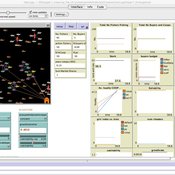
SMILI: Small-scale fisheries Institutions and Local Interactions
Emilie Lindkvist Maja Schlüter Xavier Basurto | Published Thursday, March 09, 2017The model represents an archetypical fishery in a co-evolutionary social-ecological environment, capturing different dimensions of trust between fishers and fish buyers for the establishment and persistence of self-governance arrangements.
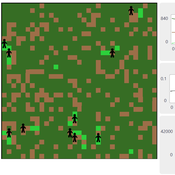
Forest Logging and Ecosystem Degradation
Carla Guerrero | Published Sunday, February 15, 2026This model simulates a forest ecosystem affected by human logging. We explore different kind of approaches and their possible consequences for the ecosystem. Loggers can either be responsible or irresponsible, they will either take care to cut trees or not. In turn their actions will have consequences on the quality of the soil, the atmosphere as well as their profit made from logging. In this model we see that even careful management cannot prevent the degradation of the forest ecosystem.
Evolution of indirect reciprocity by social information
Yunhwan Kim | Published Friday, November 02, 2012 | Last modified Saturday, April 27, 2013Indirect reciprocity can be evolved by the shared information among the people of small subgroups in the population.
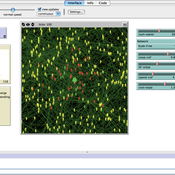
An Agent-based Model of Collective Self-organisation in Irrigation Management
Hang Xiong Jingjing Cai | Published Wednesday, April 06, 2016This model simulates how collective self-organisation among individuals that manage irrigation resource collectively.
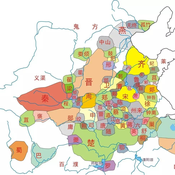
Unification-Conditions-of-Civilization-Patterns-Multi-Agent-Modeling-of-Human-History
zhuo zhang | Published Friday, May 27, 2022 | Last modified Sunday, May 29, 2022The model of Chinese and Western civilization patterns can help understand how civilizations formed, how they evolved by themselves, and the difference between the unity of China and the disunity of the Western. The previous research had examined historical phenomena about civilization patterns with subjective, static, local, and inductive methods. Therefore, we propose a general model of history dynamics for civilizations pattern, which contains both China and the West, to improve our understanding of civilization formation and the factors influencing the pattern of civilization. And at the same time, the model is used to find the boundary conditions of two different patterns.
The Groundwater Commons Game
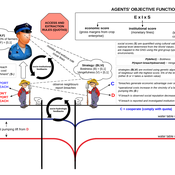
Juan Castilla-Rho Rodrigo Rojas | Published Thursday, May 11, 2017 | Last modified Saturday, September 16, 2017The Groundwater Commons Game synthesises and extends existing work on human cooperation and collective action, to elucidate possible determinants and pathways to regulatory compliance in groundwater systems globally.
The impact of potential crowd behaviours on emergency evacuation: an evolutionary game theoretic approach
Azhar Mohd Ibrahim | Published Monday, July 30, 2018Crowd dynamics have important applications in evacuation management systems relevant to organizing safer large scale gatherings. For crowd safety, it is very important to study the evolution of potential crowd behaviours by simulating the crowd evacuation process. Planning crowd control tasks by studying the impact of crowd behaviour evolution towards evacuation could mitigate the possibility of crowd disasters. During a typical emergency evacuation scenario, conflict among agents occurs when agents intend to move to the same location as a result of the interaction with their nearest neighbours. The effect of the agent response towards their neighbourhood is vital in order to understand the effect of variation of crowd behaviour on the whole environment. In this work, we model crowd motion subject to exit congestion under uncertainty conditions in a continuous space via computer simulations. We model best-response, risk-seeking, risk-averse and risk-neutral behaviours of agents via certain game theoretic notions. We perform computer simulations with heterogeneous populations in order to study the effect of the evolution of agent behaviours towards egress flow under threat conditions. Our simulation results show the relation between the local crowd pressure and the number of injured agents. We observe that when the proportion of agents in a population of risk-seeking agents is increased, the average crowd pressure, average local density and the number of injured agents increases. Besides that, based on our simulation results, we can infer that crowd disasters could be prevented if the agent population consists entirely of risk-averse and risk-neutral agents despite circumstances that lead to threats.
PoliSEA: model of Policy – Social Ecological system Adaptation
Maja Schlüter Kirill Orach | Published Thursday, March 26, 2020PoliSEA represents a continuous policy process cycle, integrated with the dynamics of a fishery social-ecological system. The policy process in the model is represented by interactions between policymakers and interest groups and subsequent voting during which policymaker decide to increase or decrease the fishing quota for the next season. Policymakers’ positions can be influenced by lobbying of interest groups or interest group coalitions. The quota adopted through the policy process determines the amount of fish that can be harvested from the fish population during the season.
A simple computational algorithm for simulating population substance use
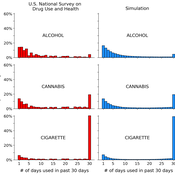
Jacob Borodovsky | Published Thursday, March 27, 2025This code simulates individual-level, longitudinal substance use patterns that can be used to understand how cross-sectional U-shaped distributions of population substance use emerge. Each independent computational object transitions between two states: using a substance (State 1), or not using a substance (State 2). The simulation has two core components. Component 1: each object is assigned a unique risk factor transition probability and unique protective factor transition probability. Component 2: each object’s current decision to use or not use the substance is influenced by the object’s history of decisions (i.e., “path dependence”).
Telephone Game
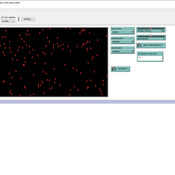
Julia Kasmire | Published Friday, January 10, 2020This is a model of a game of Telephone (also known as Chinese Whishpers in the UK), with agents representing people that can be asked, to play. The first player selects a word from their internal vocabulary and “whispers” it to the next player, who may mishear it depending on the current noise level, who whispers that word to the next player, and so on.
When the game ends, the word chosen by the first player is compared to the word heard by the last player. If they match exactly, all players earn large prize. If the words do not match exactly, a small prize is awarded to all players for each part of the words that do match. Players change color to reflect their current prize-count. A histogram shows the distribution of colors over all the players.
The user can decide on factors like
* how many players there are,
…
Displaying 10 of 534 results for "Mark Orr" clear search