An Agent-based Model of the Tragedy of the Commons (1.0.5)
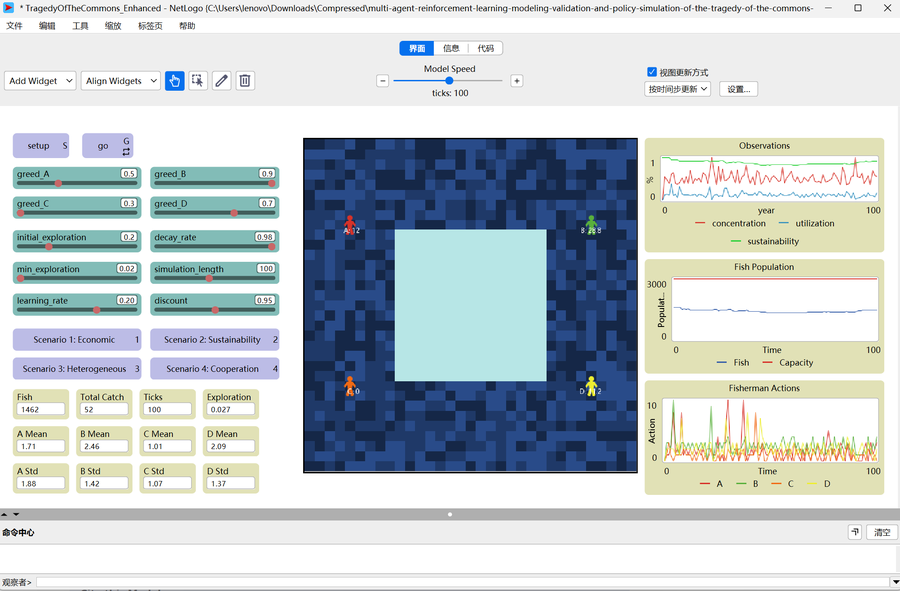
This is a model that explores how a few fishermen sharing a common fishery learn their harvesting strategies under different incentive settings, and how individual greed, cooperation, and sustainability penalties shape resource depletion and the tragedy of the commons.
Release Notes
The model is designed to simulate fishermen’s harvesting behavior in a common-pool fishery. We create a world representing a shared fishing ground with heterogeneous fishermen who compete for a limited fish stock. The fishermen are characterized by different greed factors, which affect their harvesting intensity. In each period, fishermen choose harvesting actions and receive rewards under different institutional settings, including economic incentives, sustainability penalties, heterogeneous preferences, and cooperation mechanisms. The fish population changes over time according to natural growth and total catch. The model is used to explore how individual learning, resource competition, and policy incentives shape resource depletion and the tragedy of the commons.
Associated Publications
An Agent-based Model of the Tragedy of the Commons 1.0.5
Submitted by
tao liu
Published Apr 12, 2026
Last modified Apr 18, 2026
This is a model that explores how a few fishermen sharing a common fishery learn their harvesting strategies under different incentive settings, and how individual greed, cooperation, and sustainability penalties shape resource depletion and the tragedy of the commons.
Release Notes
The model is designed to simulate fishermen’s harvesting behavior in a common-pool fishery. We create a world representing a shared fishing ground with heterogeneous fishermen who compete for a limited fish stock. The fishermen are characterized by different greed factors, which affect their harvesting intensity. In each period, fishermen choose harvesting actions and receive rewards under different institutional settings, including economic incentives, sustainability penalties, heterogeneous preferences, and cooperation mechanisms. The fish population changes over time according to natural growth and total catch. The model is used to explore how individual learning, resource competition, and policy incentives shape resource depletion and the tragedy of the commons.