Our mission is to help computational modelers develop, document, and share their computational models in accordance with community standards and good open science and software engineering practices. Model authors can publish their model source code in the Computational Model Library with narrative documentation as well as metadata that supports open science and emerging norms that facilitate software citation, computational reproducibility / frictionless reuse, and interoperability. Model authors can also request private peer review of their computational models. Models that pass peer review receive a DOI once published.
All users of models published in the library must cite model authors when they use and benefit from their code.
Please check out our model publishing tutorial and feel free to contact us if you have any questions or concerns about publishing your model(s) in the Computational Model Library.
Displaying 2 of 2 results finite automata clear search
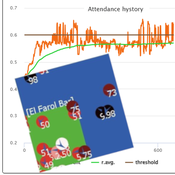
Peer reviewed Flibs’NFarol: Self-Organized Efficiency and Fairness Emergence in an Evolutive Game
Cosimo Leuci | Published Thursday, October 12, 2023According to the philosopher of science K. Popper “All life is problem solving”. Genetic algorithms aim to leverage Darwinian selection, a fundamental mechanism of biological evolution, so as to tackle various engineering challenges.
Flibs’NFarol is an Agent Based Model that embodies a genetic algorithm applied to the inherently ill-defined “El Farol Bar” problem. Within this context, a group of agents operates under bounded rationality conditions, giving rise to processes of self-organization involving, in the first place, efficiency in the exploitation of available resources. Over time, the attention of scholars has shifted to equity in resource distribution, as well. Nowadays, the problem is recognized as paradigmatic within studies of complex evolutionary systems.
Flibs’NFarol provides a platform to explore and evaluate factors influencing self-organized efficiency and fairness. The model represents agents as finite automata, known as “flibs,” and offers flexibility in modifying the number of internal flibs states, which directly affects their behaviour patterns and, ultimately, the diversity within populations and the complexity of the system.
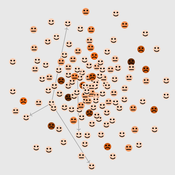
Peer reviewed Flibs'NLogo - An elementary form of evolutionary cognition
Cosimo Leuci | Published Thursday, January 30, 2020 | Last modified Monday, June 15, 2026Flibs’NLogo implements in NetLogo modelling environment, a genetic algorithm whose purpose is evolving a perfect predictor from a pool of digital creatures constituted by finite automata or flibs (finite living blobs) that are the agents of the model. The project is based on the structure described by Alexander K. Dewdney in “Exploring the field of genetic algorithms in a primordial computer sea full of flibs” from the vintage Scientific American column “Computer Recreations”.
As Dewdney summarized: “Flibs […] attempt to predict changes in their environment. In the primordial computer soup, during each generation, the best predictor crosses chromosomes with a randomly selected flib. Increasingly accurate predictors evolve until a perfect one emerges. A flib […] has a finite number of states, and for each signal it receives (a 0 or a 1) it sends a signal and enters a new state. The signal sent by a flib during each cycle of operation is its prediction of the next signal to be received from the environment”