Our mission is to help computational modelers develop, document, and share their computational models in accordance with community standards and good open science and software engineering practices. Model authors can publish their model source code in the Computational Model Library with narrative documentation as well as metadata that supports open science and emerging norms that facilitate software citation, computational reproducibility / frictionless reuse, and interoperability. Model authors can also request private peer review of their computational models. Models that pass peer review receive a DOI once published.
All users of models published in the library must cite model authors when they use and benefit from their code.
Please check out our model publishing tutorial and feel free to contact us if you have any questions or concerns about publishing your model(s) in the Computational Model Library.
Displaying 10 of 1009 results for "Rolf Anker Ims" clear search
The Regional Security Game: An Agent-based, Evolutionary Model of Strategic Evolution and Stability
Anthony Skews | Published Saturday, June 09, 2018The Regional Security Game is a iterated public goods game with punishement based on based on life sciences work by Boyd et al. (2003 ) and Hintze & Adami (2015 ), with modifications appropriate for an international relations setting. The game models a closed regional system in which states compete over the distribution of common security benefits. Drawing on recent work applying cultural evolutionary paradigms in the social sciences, states learn through imitation of successful strategies rather than making instrumentally rational choices. The model includes the option to fit empirical data to the model, with two case studies included: Europe in 1933 on the verge of war and south-east Asia in 2013.
Peer reviewed Applying Brantingham’s Neutral Model of Stone Raw Material Procurement to the Pinnacle Point Middle Stone Age Record, Western Cape, South Africa
Marco Janssen Simen Oestmo Haley Cawthra | Published Sunday, March 10, 2019This model is an application of Brantingham’s neutral model to a real landscape with real locations of potential sources. The sources are represented as their sizes during current conditions, and from marine geophysics surveys, and the agent starts at a random location in Mossel Bay Region (MBR) surrounding the Archaeological Pinnacle Point (PP) locality, Western Cape, South Africa. The agent moves at random on the landscape, picks up and discards raw materials based only upon space in toolkit and probability of discard. If the agent happens to encounter the PP locality while moving at random the agent may discard raw materials at it based on the discard probability.
MTC_Model_Pilditch&Madsen
Toby Pilditch | Published Friday, October 09, 2020Micro-targeted vs stochastic political campaigning agent-based model simulation. Written by Toby D. Pilditch (University of Oxford, University College London), in collaboration with Jens K. Madsen (University of Oxford, London School of Economics)
The purpose of the model is to explore the various impacts on voting intention among a population sample, when both stochastic (traditional) and Micto-targeted campaigns (MTCs) are in play. There are several stages of the model: initialization (setup), campaigning (active running protocols) and vote-casting (end of simulation). The campaigning stage consists of update cycles in which “voters” are targeted and “persuaded” - updating their beliefs in the campaign candidate / policies.
Team Cognition
Iris Lorscheid | Published Sunday, May 23, 2021The teamCognition model investigates team decision processes by using an agent-based model to conceptualize team decisions as an emergent property. It uses a mixed-method research design with a laboratory experiment providing qualitative and quantitative input for the model’s construction, as well as data for an output validation of the model. The agent-based model is used as a computational testbed to contrast several processes of team decision making, representing potential, simplified mechanisms of how a team decision emerges. The increasing overall fit of the simulation and empirical results indicates that the modeled decision processes can at least partly explain the observed team decisions.
Simulating the Ridesharing Economy: The Individual Agent Metro-Washington Area Ridesharing Model (IAMWARM)
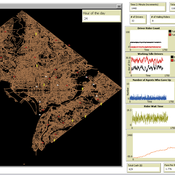
Joseph A. E. Shaheen | Published Thursday, January 27, 2022This is a ridesharing model (Uber/Lyft) of the larger Washington DC metro area. The model can be modified (Netlogo 6.x) relatively easily and be adapted to any metro area. Please cite generously (this was a lot of work) and please cite the paper, not the comses model.
Link to the paper published in “Complex Adaptive Systems” here: https://link.springer.com/chapter/10.1007/978-3-030-20309-2_7
Citation: Shaheen J.A.E. (2019) Simulating the Ridesharing Economy: The Individual Agent Metro-Washington Area Ridesharing Model (IAMWARM). In: Carmichael T., Collins A., Hadžikadić M. (eds) Complex Adaptive Systems. Understanding Complex Systems. Springer, Cham. https://doi.org/10.1007/978-3-030-20309-2_7
SLUCEII LUXE (Land Use in an eXurban Environment)
Qingxu Huang Rick L Riolo Shipeng Sun Derek Robinson Dawn Parker Tatiana Filatova Meghan Hutchins Dan Brown | Published Tuesday, September 10, 2013 | Last modified Saturday, October 22, 2022LUXE is a land-use change model featuring different levels of land market implementation. It integrates utility measures, budget constraints, competitive bidding, and market interactions to model land-use change in exurban environment.
MixFarm ABM Model
Leigh Anderson | Published Thursday, March 03, 2016MixFarmABM Model examines the competitiveness of second-generation biofuel crops with existing crops and beef cows at the farm level and their impact on the farm structure.
Evolutionary Prosocial Behavior Algorithm 1.1 (EPBA_1.1)
Andrea Ceschi | Published Tuesday, September 04, 2018In order to test how prosocial strategies (compassionate altruism vs. reciprocity) grow over time, we developed an evolutionary simulation model where artificial agents are equipped with different emotionally-based drivers that vary in strength. Evolutionary algorithms mimic the evolutionary selection process by letting the chances of agents conceiving offspring depend on their fitness. Equipping the agents with heritable prosocial strategies allows for a selection of those strategies that result in the highest fitness. Since some prosocial attributes may be more successful than others, an initially heterogeneous population can specialize towards altruism or reciprocity. The success of particular prosocial strategies is also expected to depend on the cultural norms and environmental conditions the agents live in.
Protein 2.0: An Agent-Based Model for Simulating Norway’s Protein Sector Under Carbon Pricing and the Emergence of Cultivated Proteins
Gary Polhill Nick Roxburgh Rob J.F. Burton Klaus Mittenzwei | Published Thursday, May 08, 2025Protein 2.0 is a systems model of the Norwegian protein sector designed to explore the potential impacts of carbon taxation and the emergence of cultivated meat and dairy technologies. The model simulates production, pricing, and consumption dynamics across conventional and cultivated protein sources, accounting for emissions intensity, technological learning, economies of scale, and agent behaviour. It assesses how carbon pricing could alter the competitiveness of conventional beef, lamb, pork, chicken, milk, and egg production relative to emerging cultivated alternatives, and evaluates the implications for domestic production, emissions, and food system resilience. The model provides a flexible platform for exploring policy scenarios and transition pathways in protein supply. Further details can be found in the associated publication.
Modeling Asian-Papuan Admixture during the Neolithic Expansion across Island Southeast Asia
Murray Cox François Vallée | Published Friday, December 09, 2016This Repast Simphony model simulates genomic admixture during the farming expansion of human groups from mainland Asia into the Papuan dominated islands of Southeast Asia during the Neolithic period.
Displaying 10 of 1009 results for "Rolf Anker Ims" clear search