Our mission is to help computational modelers develop, document, and share their computational models in accordance with community standards and good open science and software engineering practices. Model authors can publish their model source code in the Computational Model Library with narrative documentation as well as metadata that supports open science and emerging norms that facilitate software citation, computational reproducibility / frictionless reuse, and interoperability. Model authors can also request private peer review of their computational models. Models that pass peer review receive a DOI once published.
All users of models published in the library must cite model authors when they use and benefit from their code.
Please check out our model publishing tutorial and feel free to contact us if you have any questions or concerns about publishing your model(s) in the Computational Model Library.
Displaying 10 of 1129 results for "Bin-Tzong Chi" clear search
Metaphoria 2019 eternal mutation
Timothy Gooding | Published Sunday, February 24, 2019This model is a modification of Metaphoria 2019, where the monetary system can be run with agents that do not die, but their characteristics are mutated as they are in the mortal population.

We construct a new type of agent-based model (ABM) that can simultaneously simulate land-use changes at multiple distant places (namely TeleABM, telecoupled agent-based model). We use soybean trade between Brazil and China as an example, where Brazil is the sending system and China is the receiving system because they are the world’s largest soybean exporter and importer respectively. We select one representative county in each country to calibrate and validate the model with spatio-temporal analysis of historical land-use changes and the empirical analysis of household survey data. The whole model is programmed on RePast Simphony. The most unique features of TeleABM are that it can simulate a telecoupled system and the flows between sending and receiving systems in this telecoupled system.
Leviathan model and its approximation
Thibaut Roubin Guillaume Deffuant | Published Thursday, September 17, 2020 | Last modified Monday, September 06, 2021The model is based on the influence function of the Leviathan model (Deffuant, Carletti, Huet 2013 and Huet and Deffuant 2017). We aim at better explaining some patterns generated by this model, using a derived mathematical approximation of the evolution of the opinions averaged.
We consider agents having an opinion/esteem about each other and about themselves. During dyadic meetings, agents change their respective opinion about each other, and possibly about other agents they gossip about, with a noisy perception of the opinions of their interlocutor. Highly valued agents are more influential in such encounters.
We show that the inequality of reputations among agents have a negative effect on the opinions about the agents of low status.The mathematical analysis of the opinion dynamic shows that the lower the status of the agent, the more detrimental the interactions are for the opinions about this agent, especially when gossip is activated, while the interactions always tend to increase the opinions about agents of high status.

Software for an agent-based game-theoretic model of the contact hypothesis of prejudice reduction, to accompany “Modeling Prejudice Reduction,” in the Handbook of Computational Social Psychology, adapted from Public Affairs Quarterly 19 (2) 2005.
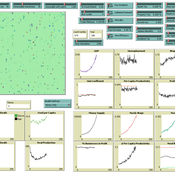
Metaphoria 2019
Timothy Gooding | Published Sunday, February 24, 2019This model test the efficiency of the market economy in comparison with a hunter/gatherer economy. It also compares the model outcomes between a market economy when using eternal agents with one using mortal agents.
Community Forest Management with Monitoring and Sanctioning
Maya Lapp Colby Long | Published Wednesday, April 29, 2020 | Last modified Friday, July 23, 2021This NetLogo ABM builds on Elena Vallino’s model of Loggers using community-based natural resource management for a forest ecosystem. In it we introduce an alternative mechanism for Logger cheating and enforcement of CBNRM rules.
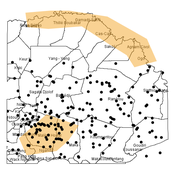
Agent-based modeling of the spatio-temporal distribution of Sahelian transhumant herds
Cheick Amed Diloma Gabriel TRAORE Etienne DELAY Alassane Bah Djibril Diop | Published Tuesday, May 20, 2025Sahelian transhumance is a seasonal pastoral mobility between the transhumant’s terroir of origin and one or more host terroirs. Sahelian transhumance can last several months and extend over hundreds of kilometers. Its purpose is to ensure efficient and inexpensive feeding of the herd’s ruminants. This paper describes an agent-based model to determine the spatio-temporal distribution of Sahelian transhumant herds and their impact on vegetation. Three scenarios based on different values of rainfall and the proportion of vegetation that can be grazed by transhumant herds are simulated. The results of the simulations show that the impact of Sahelian transhumant herds on vegetation is not significant and that rainfall does not impact the alley phase of transhumance. The beginning of the rainy season has a strong temporal impact on the spatial distribution of transhumant herds during the return phase of transhumance.
Netlogo model ` Effect of Network Homophily and Partisanship on Social Media to “Oil Spill” Polarizations’
takuya nagura | Published Saturday, September 13, 2025This model was utilized for the simulation in the paper titled Effect of Network Homophily and Partisanship on Social Media to “Oil Spill” Polarizations. It allows you to examine whether oil spill polarization occurs through people’s communication under various conditions.
・Choose the network construction conditions you’d like to examine from the “rewire-style” chooser box.
・Select the desired strength of partisanship from the “partisanlevel” chooser box. You can also set the strength manually in the code tab.
・You can set the number of dynamic topics using the “number-of-topics” slider.
・Use the “divers-of-opinion” slider to set the number of preference types for each dynamic topic.
…
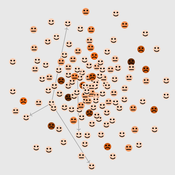
Peer reviewed Flibs'NLogo - An elementary form of evolutionary cognition
Cosimo Leuci | Published Thursday, January 30, 2020 | Last modified Monday, June 15, 2026Flibs’NLogo is an agent-based simulation implemented in NetLogo that models the evolution of perfect predictors through a genetic algorithm. The agents, called flibs (finite living blobs), are finite‑state automata whose behaviour is encoded in circular chromosomes. They inhabit a “primordial computer soup” and are tasked with anticipating a user‑defined periodic binary sequence. Each generation consists of 100 evaluation cycles, during which a flib’s fitness is incremented each time its output correctly matches the next environmental signal.
Reproduction follows an elitist scheme: a donor (current fittest individual) replaces a randomly chosen recipient either by cloning (complete genome substitution) or by bacterial‑like conjugation (unidirectional horizontal transfer of a random chromosome segment). A stochastic mutagenesis operator introduces point mutations in genes, while the reproductive strategy gene can also switch under a mixed-reproduction regime. Population dynamics are monitored via genomic diversity indices (Shannon‑Wiener, Simpson), a phenotypic simpleness metric that distinguishes the low number of states actually used from the genomic potential.
The model serves as a digital evolutionary laboratory for exploring the interplay among bounded rationality, collective adaptation, and the emergence of anticipatory behaviour. By linking evolutionary computation with cognitive concepts, Flibs’NLogo investigates fundamental transitions from reactive to predictive systems and allows for testing whether populations evolve toward minimal necessary complexity or exhibit an intrinsic drift toward structural elaboration.
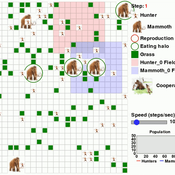
PredPreyGrass
HBP1969 | Published Sunday, May 17, 2026Exploring learned cooperation, coevolution and free-riding. Learning is achieved through Multi-Agent Deep Reinforcement Learning (MADRL) in an ecological environment. The environment emits no other than sparse reproduction rewards. No reward shaping, no explicit cooperation signal.
Displaying 10 of 1129 results for "Bin-Tzong Chi" clear search