Our mission is to help computational modelers develop, document, and share their computational models in accordance with community standards and good open science and software engineering practices. Model authors can publish their model source code in the Computational Model Library with narrative documentation as well as metadata that supports open science and emerging norms that facilitate software citation, computational reproducibility / frictionless reuse, and interoperability. Model authors can also request private peer review of their computational models. Models that pass peer review receive a DOI once published.
All users of models published in the library must cite model authors when they use and benefit from their code.
Please check out our model publishing tutorial and feel free to contact us if you have any questions or concerns about publishing your model(s) in the Computational Model Library.
Displaying 10 of 1209 results for "Ian M Hamilton" clear search
Telephone Game
Julia Kasmire | Published Friday, January 10, 2020This is a model of a game of Telephone (also known as Chinese Whishpers in the UK), with agents representing people that can be asked, to play. The first player selects a word from their internal vocabulary and “whispers” it to the next player, who may mishear it depending on the current noise level, who whispers that word to the next player, and so on.
When the game ends, the word chosen by the first player is compared to the word heard by the last player. If they match exactly, all players earn large prize. If the words do not match exactly, a small prize is awarded to all players for each part of the words that do match. Players change color to reflect their current prize-count. A histogram shows the distribution of colors over all the players.
The user can decide on factors like
* how many players there are,
…
Peer reviewed ABM Overtourism Santa Marta
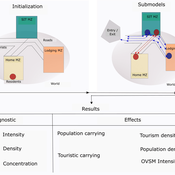
Janwar Moreno | Published Monday, October 23, 2023This model presents the simulation model of a city in the context of overtourism. The study area is the city of Santa Marta in Colombia. The purpose is to illustrate the spatial and temporal distribution of population and tourists in the city. The simulation analyzes emerging patterns that result from the interaction between critical components in the touristic urban system: residents, urban space, touristic sites, and tourists. The model is an Agent-Based Model (ABM) with the GAMA software. Also, it used public input data from statistical centers, geographical information systems, tourist websites, reports, and academic articles. The ABM includes assessing some measures used to address overtourism. This is a field of research with a low level of analysis for destinations with overtourism, but the ABM model allows it. The results indicate that the city has a high risk of overtourism, with spatial and temporal differences in the population distribution, and it illustrates the effects of two management measures of the phenomenon on different scales. Another interesting result is the proposed tourism intensity indicator (OVsm), taking into account that the tourism intensity indicators used by the literature on overtourism have an overestimation of tourism pressures.
Game of Thrones model
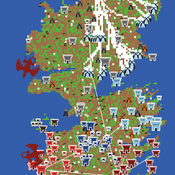
Sean Bergin Claudine Gravel-Miguel | Published Sunday, January 03, 2021 | Last modified Sunday, January 03, 2021This model slowly evolves to become Westeros, with houses fighting for the thrones, and whitewalkers trying to kill all living things. You can download each version to see the evolution of the code, from the Wolf Sheep Predation model to the Game of Thrones model. If you are only interested in the end product, simply download the latest version.
For instructions on each step, see: https://claudinegravelmigu.wixsite.com/got-abm
This model investigates how anti-conformist intentions could be related to some biases on the perception of attitudes. It starts from two case studies, related to the adoption of organic farming, that show anti-conformist intentions. It proposes an agent-based model which computes an intention based on the Theory of Reasoned Action and assumes some biases in the perception of others’ attitudes according to the Social Judgement Theory.
It investigates the conditions on the model parameter values for which the simulations reproduce the features observed in the case studies. The results suggest that perception biases are indeed likely to contribute to anti-conformist intentions.
Peer reviewed AMRO_CULEX_WNV
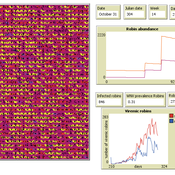
Aniruddha Belsare Jennifer Owen | Published Saturday, February 27, 2021 | Last modified Thursday, March 11, 2021An agent-based model simulating West Nile Virus dynamics in a one host (American robin)-one vector (Culex spp. mosquito) system. ODD improved and code cleaned.
Vaccine adoption with outgroup aversion using Cleveland area data
bruce1809 | Published Monday, July 31, 2023 | Last modified Sunday, August 06, 2023This model takes concepts from a JASSS paper this is accepted for the October, 2023 edition and applies the concepts to empirical data from counties surrounding and including Cleveland Ohio. The agent-based model has a proportional number of agents in each of the counties to represent the correct proportions of adults in these counties. The adoption decision probability uses the equations from Bass (1969) as adapted by Rand & Rust (2011). It also includes the Outgroup aversion factor from Smaldino, who initially had used a different imitation model on line grid. This model uses preferential attachment network as a metaphor for social networks influencing adoption. The preferential network can be adjusted in the model to be created based on both nodes preferred due to higher rank as well as a mild preference for nodes of a like group.
A minimal assumption based agent based simulation model of the emergence of technological innovation
Yuan Zhao Roland Ortt Bernhard Katzy | Published Sunday, October 19, 2014This simulation model is to simulate the emergence of technological innovation processes from the hypercycles perspective.
ForagerNet3_Demography_V3
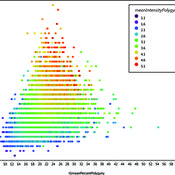
Andrew White | Published Tuesday, November 29, 2016The ForagerNet3_Demography model is a non-spatial ABM designed to serve as a platform for exploring several aspects of hunter-gatherer demography.
00 PSoup V1.22 – Primordial Soup
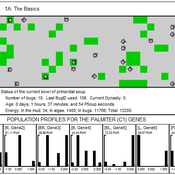
Garvin Boyle | Published Thursday, April 13, 2017PSoup is an educational program in which evolution is demonstrated, on the desk-top, as you watch. Blind bugs evolve sophisticated heuristic search algorithms to be the best at finding food fast.
Peter Diamond's Coconut Model (Heterogeneity and Learning)
Sven Banisch Eckehard Olbrich | Published Monday, May 30, 2016Agent-based version of the simple search and barter economy conceived by Peter Diamond in 1982. The model is also known as Coconut Model.
Displaying 10 of 1209 results for "Ian M Hamilton" clear search