Our mission is to help computational modelers develop, document, and share their computational models in accordance with community standards and good open science and software engineering practices. Model authors can publish their model source code in the Computational Model Library with narrative documentation as well as metadata that supports open science and emerging norms that facilitate software citation, computational reproducibility / frictionless reuse, and interoperability. Model authors can also request private peer review of their computational models. Models that pass peer review receive a DOI once published.
All users of models published in the library must cite model authors when they use and benefit from their code.
Please check out our model publishing tutorial and feel free to contact us if you have any questions or concerns about publishing your model(s) in the Computational Model Library.
Displaying 10 of 1005 results for "J Van Der Beek" clear search
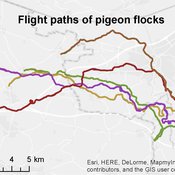
Homing pigeon model
Gudrun Wallentin | Published Saturday, October 29, 2016This model represents the flight paths of a flock of homing pigeons according to their flocking-, orientation- and leadership behaviour.
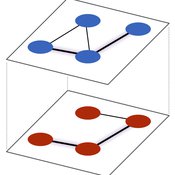
Network formation on a two-layer multiplex with shocks
Paul Smaldino | Published Monday, November 27, 2017A dynamic model of social network formation on single-layer and multiplex networks with structural incentives that vary over time.
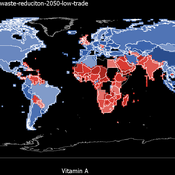
FeedUS - A global food trade model
Jiaqi Ge | Published Thursday, February 25, 2021 | Last modified Friday, February 26, 2021The purpose of the model is to study the impact of global food trade on food and nutrition security in countries around the world. It will incorporate three main aspects of trade between countries, including a country’s wealth, geographic location, and its trade relationships with other countries (past and ongoing), and can be used to study food and nutrition security across countries in various scenarios, such as climate change, sustainable intensification, waste reduction and dietary change.
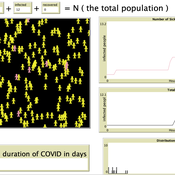
Introductory SIR Model
Kit Martin Amber Cesare Matthew Johnson | Published Tuesday, September 28, 2021This is a basic Susceptible, Infected, Recovered (SIR) model. This model explores the spread of disease in a space. In particular, it explores how changing assumptions about the number of susceptible people, starting number of infected people, as well as the disease’s infection probability, and average duration of infection. The model shows that the interactions of agents can drastically affect the results of the model.
We used it in our course on COVID-19: https://www.csats.psu.edu/science-of-covid19
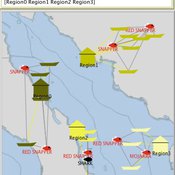
The Mobility Model
Emilie Lindkvist | Published Wednesday, September 27, 2017 | Last modified Friday, October 06, 2017The Mobility Model is a model of a small-scale fishery with the purpose to study the movement of fishers between different sub-regions within a larger region, as they move between different regions to fish.
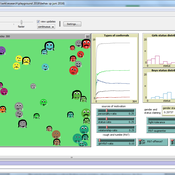
THE STATUS ARENA
Gert Jan Hofstede Jillian Student Mark R Kramer | Published Wednesday, June 08, 2016 | Last modified Tuesday, January 09, 2018Status-power dynamics on a playground, resulting in a status landscape with a gender status gap. Causal: individual (beauty, kindness, power), binary (rough-and-tumble; has-been-nice) or prior popularity (status). Cultural: acceptability of fighting.
ManPest
François Rebaudo | Published Tuesday, February 25, 2014 | Last modified Wednesday, August 27, 2014The purpose of the model is to explore the impacts of global change on the ability of a community of farmers to adapt their practices to an agricultural pest.
NetPlop: A moderately-featured presentation editor built in NetLogo
Patrick Steinmann | Published Saturday, March 27, 2021NetPlop is a presentation editor built entirely in NetLogo, an agent-based modelling environment. The NetPlop Editor includes a variety of tools to design slide decks, and the Viewer allows these decks to be dis-played to an enraptured audience. A key feature of NetPlop is the ability to embed agent-based models. NetPlop was developed for SIGBOVIK 2021.
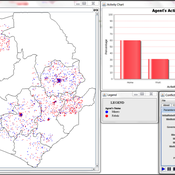
The Geography of Conflict Diamonds: The Case of Sierra Leone
Andrew Crooks Bianica Pires | Published Thursday, March 24, 2016 | Last modified Thursday, March 24, 2016Using Sierra Leone as a test case, the purpose of the model is to explore the role of geography in a resource-driven war. An ABM is integrated with geographic information systems (GIS) for this purpose.
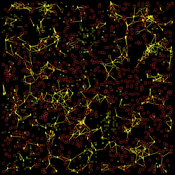
The Internal Organizational Plasticity Model (IOP 2.1.2)
Davide Secchi | Published Tuesday, June 02, 2020IOP 2.1.2 is an agent-based simulation model designed to explore the relations between (1) employees, (2) tasks and (3) resources in an organizational setting. By comparing alternative cognitive strategies in the use of resources, employees face increasingly demanding waves of tasks that derive by challenges the organization face to adapt to a turbulent environment. The assumption tested by this model is that a successful organizational adaptation, called plastic, is necessarily tied to how employees handle pressure coming from existing and new tasks. By comparing alternative cognitive strategies, connected to ‘docility’ (Simon, 1993; Secchi, 2011) and ‘extended’ cognition (Clark, 2003, Secchi & Cowley, 2018), IOP 2.1.2 is an attempt to indicate which strategy is most suitable and under which scenario.
Displaying 10 of 1005 results for "J Van Der Beek" clear search