Our mission is to help computational modelers develop, document, and share their computational models in accordance with community standards and good open science and software engineering practices. Model authors can publish their model source code in the Computational Model Library with narrative documentation as well as metadata that supports open science and emerging norms that facilitate software citation, computational reproducibility / frictionless reuse, and interoperability. Model authors can also request private peer review of their computational models. Models that pass peer review receive a DOI once published.
All users of models published in the library must cite model authors when they use and benefit from their code.
Please check out our model publishing tutorial and feel free to contact us if you have any questions or concerns about publishing your model(s) in the Computational Model Library.
Displaying 10 of 806 results NetLogo clear search

How to not get stuck – an ant model showing how negative feedback due to crowding maintains flexibility in ant foraging
Tomer Czaczkes | Published Thursday, December 17, 2015Positive feedback can lead to “trapping” in local optima. Adding a simple negative feedback effect, based on ant behaviour, prevents this trapping
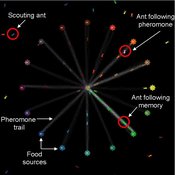
Composite Collective Decision Making - ant colony foraging model
Tomer Czaczkes Benjamin I Czaczkes | Published Thursday, December 17, 2015The model explores how two types of information - social (in the form of pheromone trails) and private (in the form of route memories) affect ant colony level foraging in a variable enviroment.
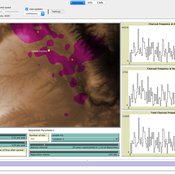
Charcoal Record Simulation Model (CharRec)
Grant Snitker | Published Monday, November 16, 2015 | Last modified Thursday, September 30, 2021This model (CharRec) creates simulated charcoal records, based on differing natural and anthropogenic patterns of ignitions, charcoal dispersion, and deposition.
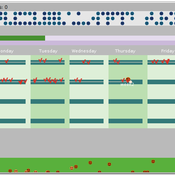
Health and social public information office (SPUN) simulation
Emilio Sulis Manuela Vinai | Published Friday, November 06, 2015 | Last modified Saturday, November 07, 2015The program simulate the functioning of an italian health and social public information office (SPUN) on the basis of the real data collected in the first five years of functioning.
Agent-based model for centralized student admission process
Connie Wang Shu-Heng Chen Bin-Tzong Chi | Published Wednesday, November 04, 2015 | Last modified Wednesday, March 06, 2019This model is to match students and schools using real-world student admission mechanisms. The mechanisms in this model are serial dictatorship, deferred acceptance, the Boston mechanism, Chinese Parallel, and the Taipei mechanism.
The relationship between product information quantity and diversity of consumer decisions
Marco Janssen Takao Sasaki David Vaughn Becker Rebecca Neel | Published Tuesday, October 27, 2015We developed an agent-based model to explore underlying mechanisms of behavioral clustering that we observed in human online shopping experiments.
Influence with over-confident agents
Juliette Rouchier Emily Tanimura | Published Wednesday, October 21, 2015Agents can influence each other if they are close enough in knowledge. The probability to convince with good knowledge and number of agents have an impact on the dissemination of knowledge.
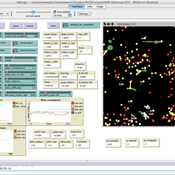
Inquisitiveness in ad hoc teams
Davide Secchi | Published Sunday, October 18, 2015 | Last modified Thursday, June 11, 2020This model builds on inquisitiveness as a key individual disposition to expand the bounds of their rationality. It represents a system where teams are formed around problems and inquisitive agents integrate competencies to find ‘emergent’ solutions.
Intra-Organizational Bandwagon
Davide Secchi | Published Sunday, October 18, 2015The model simulates the process of widespread diffusion of something due to popularity (i.e., bandwagon) within an organization.
EthnoCultural Tag model (ECT)
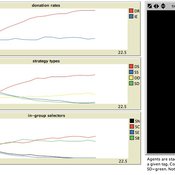
Bruce Edmonds David Hales | Published Friday, October 16, 2015 | Last modified Wednesday, May 09, 2018Captures interplay between fixed ethnic markers and culturally evolved tags in the evolution of cooperation and ethnocentrism. Agents evolve cultural tags, behavioural game strategies and in-group definitions. Ethnic markers are fixed.
Displaying 10 of 806 results NetLogo clear search