Our mission is to help computational modelers develop, document, and share their computational models in accordance with community standards and good open science and software engineering practices. Model authors can publish their model source code in the Computational Model Library with narrative documentation as well as metadata that supports open science and emerging norms that facilitate software citation, computational reproducibility / frictionless reuse, and interoperability. Model authors can also request private peer review of their computational models. Models that pass peer review receive a DOI once published.
All users of models published in the library must cite model authors when they use and benefit from their code.
Please check out our model publishing tutorial and feel free to contact us if you have any questions or concerns about publishing your model(s) in the Computational Model Library.
Displaying 10 of 243 results for "Paulien Herder" clear search
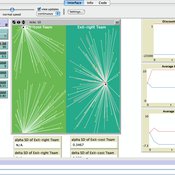
Simulation of Self-enforcing Agreement in Cooperative Teams
Hang Xiong | Published Friday, April 01, 2016This is an agent-based model of the implementation of the self-enforcing agreement in cooperative teams.
Spatiotemporal Visualization of Emotional and Emotional-related Mental States
Luis Macedo | Published Monday, November 07, 2011 | Last modified Saturday, April 27, 2013A system that receives from an agent-based social simulation the agent’s emotional data, their emotional-related data such as motivations and beliefs, as well as their location, and visualizes of all this information in a two dimensional map of the geographic region the agents inhabit as well as on graphs along the time dimension.
This model presents an autonomous, two-lane driving environment with a single lane-closure that can be toggled. The four driving scenarios - two baseline cases (based on the real-world) and two experimental setups - are as follows:
- Baseline-1 is where cars are not informed of the lane closure.
- Baseline-2 is where a Red Zone is marked wherein cars are informed of the lane closure ahead.
- Strategy-1 is where cars use a co-operative driving strategy - FAS. <sup>[1]</sup>
- Strategy-2 is a variant of Strategy-1 and uses comfortable deceleration values instead of the vehicle’s limit.
…
Hollywood Underrepresentation Simulated Causes
Carmen Iasiello | Published Sunday, November 26, 2023Presented here is a socioeconomic agent-based model (ABM) to examine the Hollywood labor system as a network within a simulated movie labor market based on preferential attachment and compare the findings with 50 co-production ego networks during the 2015 movie year. Using the ABM, I test the role slight individual preference for racial and ethnic similarity within one’s own network at the microlevel and find that it is insufficient to explain the phenomena of racial and ethnic underrepresentation at the macrolevel. The ABM also includes the ability to test alternative explanations, such as overt opportunity loss as a possible explanation.
Incentives for data sharing
Flaminio Squazzoni Federico Bianchi Thomas Klebel Tony Ross-Hellauer | Published Thursday, October 02, 2025Although beneficial to scientific development, data sharing is still uncommon in many research areas. Various organisations, including funding agencies that endorse open science, aim to increase its uptake. However, estimating the large-scale implications of different policy interventions on data sharing by funding agencies, especially in the context of intense competition among academics, is difficult empirically. Here, we built an agent-based model to simulate the effect of different funding schemes (i.e., highly competitive large grants vs. distributive small grants), and varying intensity of incentives for data sharing on the uptake of data sharing by academic teams strategically adapting to the context.
A simple Multi-Agent System of the Tragedy Of the Commons (MASTOC-s)
Julia Schindler | Published Friday, June 29, 2012 | Last modified Saturday, April 27, 2013This is a simple model replicating Hardin’s Tragedy of the Commons using reactive agents that have psychological behavioral and social preferences.
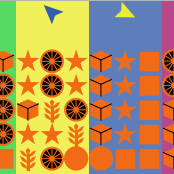
InnovationGame
Madeline Tyson | Published Thursday, August 24, 2017This model includes an innovation search environment. Agents search and can share their findings. It’s implemented in Netlogo-Hubnet & a parallel Netlogo model. This allows for validation of search strategies against experimental findings.
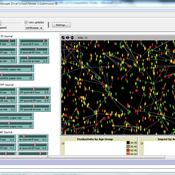
Modelling Academics as Agents: An Implementation of an Agent-Based Strategic Publication Model
Keith Nesbitt Xin Gu David Cornforth Karen Blackmore | Published Wednesday, July 23, 2014 | Last modified Wednesday, July 13, 2022The purpose of this agent-based model is to explore the emergent phenomena associated with scientific publication, including quantity and quality, from different academic types based on their publication strategies.
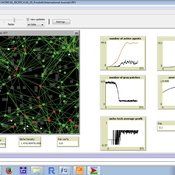
Emerging innovation niches model
Antonio Lopolito Richard Taylor Piergiuseppe Morone | Published Monday, September 22, 2014Objective of our model is to simulate the emergence and operation of a technological niches (TN) in terms of actors’ interaction. A TN can be conceived as protected socio-economic space where radical innovations are developed and tested
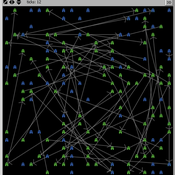
Exploring organizational learning in innovation networks. An agent-based model
Sandra Schmid | Published Saturday, March 07, 2015This agent-based model represents a stylized inter-organizational innovation network where firms collaborate with each other in order to generate novel organizational knowledge.
Displaying 10 of 243 results for "Paulien Herder" clear search