Our mission is to help computational modelers develop, document, and share their computational models in accordance with community standards and good open science and software engineering practices. Model authors can publish their model source code in the Computational Model Library with narrative documentation as well as metadata that supports open science and emerging norms that facilitate software citation, computational reproducibility / frictionless reuse, and interoperability. Model authors can also request private peer review of their computational models. Models that pass peer review receive a DOI once published.
All users of models published in the library must cite model authors when they use and benefit from their code.
Please check out our model publishing tutorial and feel free to contact us if you have any questions or concerns about publishing your model(s) in the Computational Model Library.
Displaying 10 of 45 results for "Chao Ding" clear search
Urban waterlogging disaster evaluation based on complex network a case study of Zhengzhou, China
Chao Ding Jia Xu | Published Monday, April 17, 2023The model constructs a complex network of traffic based on the main urban area of Zhengzhou, China, and simulates the urban rainfall process using the ABM model to analyse the real-time risk of flooding hazards in the nodes of the complex network.
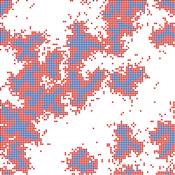
Increased costs of cooperation help cooperators in the long run
Paul Smaldino | Published Wednesday, March 01, 2017A spatial prisoner’s dilemma model with mobile agents, de-coupled birth-death events, and harsh environments.
A Replication of Rolf Zieglers Kula Ring Simulation
Rhian Stotts | Published Tuesday, December 16, 2008 | Last modified Saturday, April 27, 2013This model is a simulation of the ceremonial exchange network in Papua New Guinea called the Kula Ring. In the Kula Ring, there are two types of gifts that travel in opposite directions: armshells co
DINO model - Dynamics of Internalization and Dissemination of Norms
Marlene Batzke | Published Wednesday, January 11, 2023 | Last modified Saturday, August 19, 2023The DINO model (Dynamics of Internalization and Dissemimnation of Norms) simulates a conceptual model on the dynamics of norm internalization in the decision-making framework of a 3-person prisoner’s dilemma game.
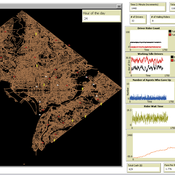
Simulating the Ridesharing Economy: The Individual Agent Metro-Washington Area Ridesharing Model (IAMWARM)
Joseph A. E. Shaheen | Published Thursday, January 27, 2022This is a ridesharing model (Uber/Lyft) of the larger Washington DC metro area. The model can be modified (Netlogo 6.x) relatively easily and be adapted to any metro area. Please cite generously (this was a lot of work) and please cite the paper, not the comses model.
Link to the paper published in “Complex Adaptive Systems” here: https://link.springer.com/chapter/10.1007/978-3-030-20309-2_7
Citation: Shaheen J.A.E. (2019) Simulating the Ridesharing Economy: The Individual Agent Metro-Washington Area Ridesharing Model (IAMWARM). In: Carmichael T., Collins A., Hadžikadić M. (eds) Complex Adaptive Systems. Understanding Complex Systems. Springer, Cham. https://doi.org/10.1007/978-3-030-20309-2_7
NetLogo-R-Example for the Inititialisation of Agents with Correlated Random Numbers
Danilo Saft | Published Friday, February 14, 2014 | Last modified Monday, April 08, 2019This is a short NetLogo example demonstrating how to initialize 500 agents with 4 correlated parameters each with random values by doing the necessary calculations in the program “R” and retrieving the results.
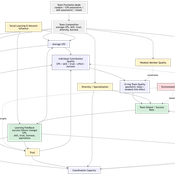
Peer reviewed Cognitive Problem-Solving Capacity, Trust, and O-Ring Team Productivity
Taseer Salahuddin Hasan Vergil Muhammad Abdullah Yasser | Published Saturday, August 08, 2026This is a NetLogo 7.0.1 agent-based model of interdependent team productivity under O-ring production logic. The model asks when collective problem-solving capacity (CPS) improves team output and when its effect is constrained by trust, burnout, specialization diversity, weak-link quality, and team-formation rules. Agents are heterogeneous in skill, CPS, trust, burnout, effort, learning rate, openness, specialization, adaptability, and aspiration. Each tick forms temporary teams, computes individual contribution quality, combines contributions through a geometric O-ring production function with an explicit weakest-link term, records output and success, and updates agents through feedback, learning, trust change, burnout, recovery, and turnover. The paper follows the ODD protocol, reports exact implementation equations, and analyzes six BehaviorSpace experiments with 50 stochastic repetitions per condition. Scenario results show that CPS is beneficial but not sufficient: productivity is highest when CPS is combined with trust, low burnout, effective coordination, and a reliable weakest-link floor. Diversity yields only modest gains at low CPS but larger gains when CPS is high. Formation-mode results are especially informative because mixed CPS-skill formation maximizes total output, whereas random formation has the highest binary success rate, showing that output magnitude and threshold success can diverge. The study contributes a transparent computational mechanism linking collective intelligence with O-ring production and identifies boundary conditions under which high-CPS teams can still be limited by weak links and interdependence.
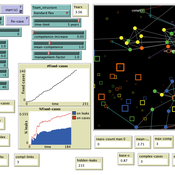
Team Structure and Task Performance
Davide Secchi Martin Neumann | Published Monday, August 05, 2024This model was designed to study resilience in organizations. Inspired by ethnographic work, it follows the simple goal to understand whether team structure affects the way in which tasks are performed. In so doing, it compares the ‘hybrid’ data-inspired structure with three more traditional structures (i.e. hierarchy, flexible/relaxed hierarchy, and anarchy/disorganization).
Peer reviewed Agent-Based Ramsey growth model with endogenous technical progress (ABRam-T)
Sarah Wolf Aida Sarai Figueroa Alvarez Malika Tokpanova | Published Wednesday, February 14, 2024 | Last modified Monday, February 19, 2024The Agent-Based Ramsey growth model is designed to analyze and test a decentralized economy composed of utility maximizing agents, with a particular focus on understanding the growth dynamics of the system. We consider farms that adopt different investment strategies based on the information available to them. The model is built upon the well-known Ramsey growth model, with the introduction of endogenous technical progress through mechanisms of learning by doing and knowledge spillovers.
Friendship Games Rev 1.0
David Dixon | Published Friday, October 07, 2011 | Last modified Saturday, April 27, 2013A friendship game is a kind of network game: a game theory model on a network. This is a NetLogo model of an agent-based adaptation of “‘Friendship-based’ Games” by PJ Lamberson. The agents reach an equilibrium that depends on the strategy played and the topology of the network.
Displaying 10 of 45 results for "Chao Ding" clear search