Our mission is to help computational modelers develop, document, and share their computational models in accordance with community standards and good open science and software engineering practices. Model authors can publish their model source code in the Computational Model Library with narrative documentation as well as metadata that supports open science and emerging norms that facilitate software citation, computational reproducibility / frictionless reuse, and interoperability. Model authors can also request private peer review of their computational models. Models that pass peer review receive a DOI once published.
All users of models published in the library must cite model authors when they use and benefit from their code.
Please check out our model publishing tutorial and feel free to contact us if you have any questions or concerns about publishing your model(s) in the Computational Model Library.
Displaying 10 of 195 results for "Brant M Horio" clear search
Modeling a Victim-Centered Approach for Detection of Human Trafficking Victims within Migration Flows
Kyle Ballard Brant M Horio | Published Saturday, September 23, 2017The model employs an agent-based model for exploring the victim-centered approach to identifying human trafficking and the approach’s effectiveness in an abstract representation of migrant flows.
PR-M: The Peer Review Model
Mario Paolucci Francisco Grimaldo | Published Sunday, November 10, 2013 | Last modified Wednesday, July 01, 2015This is an agent-based model of peer review built on the following three entities: papers, scientists and conferences. The model has been implemented on a BDI platform (Jason) that allows to perform both parameter and mechanism exploration.
Gender Dynamics at a Naturist Venue (infinite capacity)
James Junghanns | Published Tuesday, February 03, 2026Manipulate[
Module[{fDot, mDot, poly, roots, stableRoots, rStar, rIso,
endPointStar, endPointIso},(1. Define the System Dynamics)
fDot = phi1(f/m) - phi2(m/f);
mDot = mu1(f/m) - mu2(m/f);
(*2. Find the Equilibrium Ratio r=f/
…
Mikania micrantha control in western Chitwan community forests
Jie Dai | Published Thursday, August 20, 2020This model simulates the household participation in large-scale M. micrantha intervention campaigns and the response of M. micrantha to the intervention.
Institutions and Cooperation in an Ecology of Games
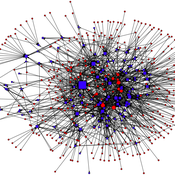
Paul Smaldino | Published Wednesday, November 29, 2017Dynamic bipartite network model of agents and games in which agents can participate in multiple public goods games.
The Effect of Merger and Acquisitions on the IS Function: An Agent Based Simulation Model
Andrea Genovese | Published Tuesday, June 23, 2009 | Last modified Saturday, April 27, 2013Merger and acquisition (M&A) activity has many strategic and operational objectives. One operational objective is to develop common and efficient information systems that maybe the source of creating
A Multi-level Multi-model of Collective Motion
Benjamin Camus Christine Bourjot Vincent Chevrier | Published Wednesday, March 25, 2015This multi-model (i.e. a model composed of interacting submodels) is a multi-level representation of a collective motion phenomenon. It was designed to study the impact of the mutual influences between individuals and groups in collective motion.
Peer reviewed Modelling the Social Complexity of Reputation and Status Dynamics
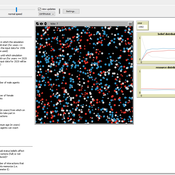
André Grow Andreas Flache | Published Wednesday, February 01, 2017 | Last modified Wednesday, January 23, 2019The purpose of this model is to illustrate the use of agent-based computational modelling in the study of the emergence of reputation and status beliefs in a population.
Symmetric two-sided matching
Naoki Shiba | Published Wednesday, January 09, 2013 | Last modified Wednesday, May 29, 2013This is a replication model of the matching problem including the mate search problem, which is the generalization of a traditional optimization problem.
Gini Palma microsimulation
Edgar Oliveira | Published Wednesday, December 11, 2024The model is a microsimulation, where the agents don’t Interact with each other. It simulates income distribution, unemployment dynamics, education, and Family grant in Brazil, focusing on the impact on social inequality. It tracks the indicators Gini index, Lorenz curve, and Palma ratio. The objective is to explore how these factors influence wealth distribution and social inequality over time.
This work was developed in partnership with the Graduate Program in Computational Modeling, in the Universidade Federal do Rio Grande - FURG, in Brazil.
Displaying 10 of 195 results for "Brant M Horio" clear search